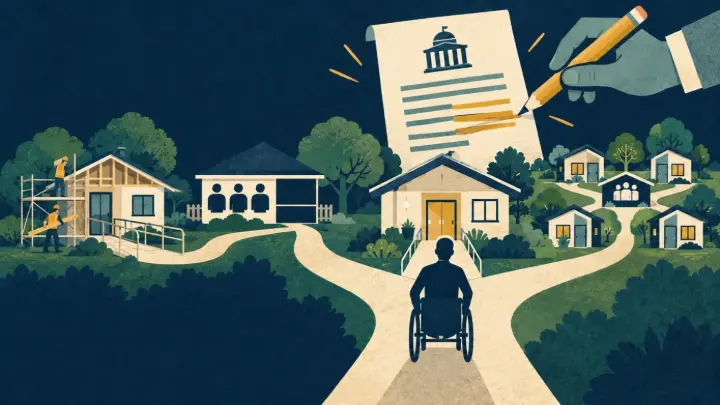
The Government Is Rethinking SIL.
What Could Come Next?
As Australia government considers changes to Supported Independent Living, could flexible support ratios and purpose-built housing provide greater choice, stability and independence?
A home should be the place where a person feels safest.
It should be where they decide when to wake up, what to eat, who visits and how they spend their day. For people who need assistance around the clock, those ordinary choices can depend on a complicated arrangement of funding, housing, support workers and shared staffing.
That arrangement is known as Supported Independent Living, or SIL.
When SIL works well, it gives a person more than practical assistance. It offers stability, familiarity and the confidence to live with greater independence.
When it fails, the consequences are deeply personal.
A person may be asked to live with housemates they did not choose. Their trusted support workers may change repeatedly. They may have to move because another resident leaves and the house is no longer financially viable. In the worst cases, the breakdown of a support arrangement can mean hospitalisation, crisis accommodation or the loss of a place they had come to regard as home.
This is why conversations about the future of SIL cannot be reduced to vacancies, ratios and operating costs.
But those numbers cannot be ignored either.
SIL is not under pressure because people no longer need supported housing. It is under pressure because traditional shared housing and fixed-ratio staffing models can be financially fragile. When one part of the arrangement changes, the stability of the entire home may be placed at risk.
When the numbers no longer match real life
Many traditional SIL homes operate through shared support.
One worker may support two or three people during certain parts of the day. Participants may then receive individual support for personal care, community participation or activities requiring closer assistance.
On paper, the arrangement can appear straightforward.
Real life rarely is.
One resident may enter hospital. Another may move closer to family. A vacant room may remain empty because the people being referred are not compatible with those already living in the home. A participant’s funding may change even though their practical support needs remain largely the same.
The roster cannot always be changed overnight.
People still need help getting out of bed, preparing meals, taking medication and moving safely through their day. Support workers must still be available, even when the funding attached to the original shared ratio is no longer there.
The provider is then left carrying hours of support that may not be fully funded.
This is often described as “ratio drift”. Its consequences are human. If the gap becomes too large, a provider may reduce staffing, withdraw from the service or close the home altogether.
For the person who relies on that support, the result can be devastating.
National financial benchmarking illustrates the scale of the challenge. The Stewart Brown Disability Services Financial Benchmark Report 2023 examined 977 SIL homes and found that 41.6 per cent were operating at a loss.
That does not mean SIL itself is failing. It means too many SIL homes depend on arrangements that can become unstable when occupancy, participant needs or funded support ratios change.
A financially unsustainable service cannot provide a permanently secure home.
Will 1:3 become the new SIL ratio?
The NDIS Review’s recommendations on housing and living supports proposed that people requiring 24-hour living support would generally be funded on the basis of one support worker shared between three participants.
This has led to understandable concern that 1:3 could become a blanket ratio across SIL.
It should not.
A support ratio is a funding and staffing arrangement. It is not a measure of a person’s worth or the maximum amount of attention they deserve.
Some people can safely share support during quieter periods of the day. They may still need individual assistance with personal care, medication, behavioural support or community activities.
Others have complex needs that make shared support unsafe or impractical. The NDIS Review itself recognised that exceptions would be necessary.
The future of SIL is therefore unlikely to be one worker supporting three people at all times. A more realistic model would combine different forms of assistance according to each participant’s needs:
- Shared support when it is safe and appropriate.
- Individual support during higher-need activities.
- Active overnight or sleepover assistance.
- Scheduled or drop-in support for people who do not need continuous staffing.
The important shift is not simply from 1:2 to 1:3.
It is from rigid ratios towards support that can change as a person’s life and circumstances change.
Sharing support does not mean surrendering privacy
For many years, sharing support has usually meant sharing a house.
That may suit some people. Good housemates can offer companionship, friendship and a sense of community.
However, a shared home is not the right choice for everyone.
Imagine being told that the support you need is available, but only if you live with people selected largely because their funding makes the house financially workable.
You may have little say over who uses the kitchen, who invites visitors into the home or whether another resident’s routines are compatible with your own. For somebody living with psychosocial disability, trauma or sensory sensitivities, that lack of control can be overwhelming.
A poor housemate match is not a minor inconvenience. It can turn a home into a source of daily anxiety and ultimately cause the placement to break down.
The NDIS Review made an important distinction: sharing support does not mean participants must share a home.
This is where purpose-built clustered housing presents a meaningful alternative.
Instead of several participants sharing every domestic space, each person could live in a self-contained unit with their own bedroom, bathroom, kitchenette and outdoor area. Support workers could remain close by and provide shared, individual or overnight assistance across a small, carefully planned site.
Explore our approach: Urban Village
Participants would retain their own front door and personal space without being isolated from support.
In simple terms, people could share assistance without being forced to share their entire lives.
A building alone is not the answer
Clustered accommodation should not be treated as an automatic solution.
A poorly managed cluster could reproduce the same problems found in traditional group homes, only across several smaller units.
The success of the model would depend on how it is operated.
Participants must have meaningful choice over where they live and who provides their support. Tenancy arrangements should be clear and should not be used to prevent someone from changing providers. Support must remain responsive to individual needs rather than being designed solely around the most profitable roster.
Safeguarding, workforce capability and careful participant matching will remain essential.
Occupancy will matter, but the objective cannot simply be to fill every available unit. Placing an unsuitable person into a development may solve an immediate vacancy problem while destabilising the people already living there.
The right question is not, “How quickly can this place be filled?”
It is, “Can this person build a safe and stable life here?”
What could the next NDIS arrangement look like?
The Australian Government is consulting on the future of SIL, including whether a commissioning approach could improve the safety, quality, innovation and sustainability of services.
Commissioning could give the government a more active role in how some SIL services are planned, funded, delivered and monitored.
No final model has been decided. The consultation should not be mistaken for confirmation that either commissioning or a universal 1:3 ratio will proceed.
However, the direction points towards a more structured and accountable system.
Future arrangements could involve:
- More consistent assessment of housing and living support needs.
- Shared support generally funded at a 1:3 ratio for participants requiring 24-hour assistance, with exceptions for higher or more complex needs.
- Greater government involvement in planning, funding and monitoring some SIL services.
- Stronger registration, safeguarding and quality requirements.
- Clearer separation between a participant’s tenancy and their support provider.
- More flexible housing models that allow people to share support without necessarily sharing a home.
- Closer scrutiny of whether funded support ratios match the assistance being delivered.
Some changes have already begun. From 1 July 2026, SIL providers became subject to mandatory registration and new SIL Practice Standards.
The standards place greater emphasis on participants’ voices, rights and freedoms while strengthening expectations around quality, safeguarding and provider accountability. The full requirements are set out in the SIL supplementary module of the NDIS Practice Standards.
This does not necessarily mean that less money will be allocated to SIL.
The more immediate concern is that funding may become more tightly assessed and controlled while providers continue to face rising wages, property expenses and compliance costs.
Providers will need to demonstrate that their services genuinely improve participants’ lives while remaining viable when occupancy, funding or support needs change.
Whatever arrangement emerges, it must avoid replacing one rigid model with another.
Consistency may improve fairness, but consistency without flexibility overlooks the reality that people’s needs and their lives do not fit neatly into standard formulas.
What should the future of SIL feel like?
Policy discussions tend to focus on systems: commissioning, price limits, ratios, registration and market sustainability.
Participants experience SIL differently.
They experience it as the worker who arrives on time and knows how they take their coffee. It is the confidence to cook a meal, attend an appointment or invite family over. It is knowing that help is nearby without feeling watched in their own home.
That human experience should be the test of every future SIL model.
A good service should feel reliable without being controlling. Support should be present without taking over. A person’s home should remain their home, rather than their provider’s workplace or a funding arrangement held together by full occupancy.
The next generation of supported living
Traditional shared homes will not disappear, nor should they. For some people, living with compatible housemates will remain a positive and freely chosen arrangement.
But it should no longer be treated as the default answer for everyone requiring 24-hour support.
The future is likely to involve a broader mix of shared homes, self-contained units, clustered developments, individualised living arrangements and community-based assistance.
Purpose-built clustered housing offers one of the strongest possibilities because it addresses both sides of the SIL challenge. It can give participants greater independence and privacy while enabling providers to coordinate shared support more sustainably.
The model will only succeed if participant choice remains more important than operational convenience.
SIL is not failing because people do not need support. It is under pressure because too many existing arrangements rely on fixed ratios, full occupancy and shared housing that cannot easily adapt when life changes.
The future should not be about fitting people into houses or forcing their needs into a predetermined ratio.
It should be about building homes and support systems flexible enough to fit around people.
Because behind every SIL ratio is a person.
And behind every vacancy is a home somebody may be hoping to find—or desperately trying not to lose.
Have your say on the future of SIL
As an experienced SIL provider, we welcome the opportunity to contribute our practical insights to the Australian Government’s consultation. We also encourage participants, families, carers, providers and community members to share their perspectives. These voices will be essential in shaping a fairer, more sustainable and person-centred future for SIL.
You can participate by completing the online survey, uploading a written submission or video, emailing your submission, or requesting a conversation by phone. Visit the Australian Government’s SIL consultation page to have your say.
Sources
- Australian Government: Have your say on the future of Supported Independent Living
- NDIS Review: Housing and living supports
- NDIS Review: Guide for people with disability and their families
- NDIS Quality and Safeguards Commission: SIL Practice Standards reform
- NDIS Quality and Safeguards Commission: Supplementary SIL Practice Standards
- Stewart Brown: Disability Services Financial Benchmark Report 2023
- NDIS: What is Supported Independent Living?