Governments have committed billions to disability support, but questions remain about the help available outside the NDIS. National research estimated that 493,600 Australians aged 12 to 64 with moderate or severe mental illness had unmet government-funded psychosocial support needs in 2022–23. As NDIS reforms progress and Foundational Supports begins with a children's programme, questions remain about what additional support will be available to adults with psychosocial disability outside the scheme.
Key points
- An estimated 493,600 Australians aged 12 to 64 with moderate or severe mental illness were not receiving the government-funded psychosocial support they needed in 2022–23 (Health Policy Analysis, 2024).
- The National Agreement on Foundational Supports, signed in February 2026, caps joint funding at $10 billion over 5 years. Its first phase, Thriving Kids, is for children aged 8 and under. The agreement identifies psychosocial support as a possible form of targeted assistance but does not establish a dedicated adult cohort, funding allocation or commencement date. NDIS reforms announced in April 2026 include changes to eligibility assessments, scheduled to begin for new applicants in January 2028, with existing participants progressively reassessed over three years. The Support Gap Beyond the NDIS
- Australia spends billions on disability and mental health services, but that funding does not tell us how many people can actually get help with everyday living. A national study prepared for the Australian Government estimated that 493,600 Australians aged 12 to 64 with moderate or severe mental illness were not receiving the government-funded psychosocial support they needed in 2022–23.
These estimates reflect unmet needs in 2022–23 rather than the current situation. They also raise an important question: what support is available to people who need ongoing assistance but are not eligible for the National Disability Insurance Scheme (NDIS)? The NDIS does not cover every form of mental health or disability support. People who do not meet its eligibility requirements may still need assistance with everyday living. For someone looking for support, the important questions are whether a service operates in their area, whether they qualify and how long they might have to wait.
How many Australians are missing out on psychosocial support?
Health Policy Analysis measured the scale of unmet psychosocial support need in a national study for the Australian Government Department of Health and Aged Care.
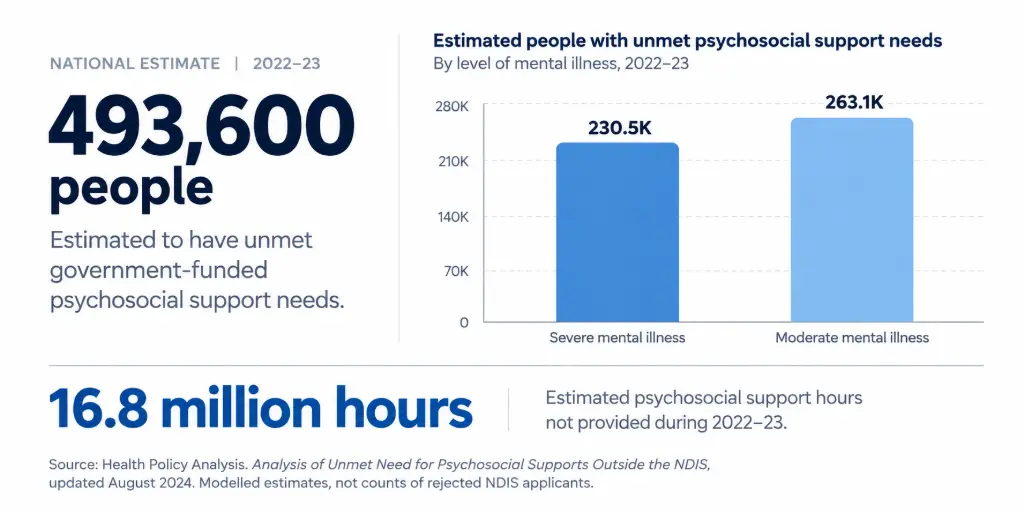
The report, updated in August 2024, estimated that 493,600 Australians aged 12 to 64 with moderate or severe mental illness needed psychosocial support in 2022–23 and were not getting it through the NDIS or any other government-funded program.
Of those estimated to have unmet needs, 230,500 were living with severe mental illness and 263,100 with moderate mental illness. The report also estimated that 16.8 million hours of psychosocial support were needed but not provided during that financial year.
These estimates provide a starting point for future research to assess whether unmet psychosocial support needs are increasing or decreasing.
NDIS Access and Psychosocial Disability
The NDIS funds individual support for eligible people with disability, including people whose mental health condition causes significant psychosocial disability. A diagnosis alone does not establish eligibility. Applicants must meet the scheme’s access requirements, which turn on functional impact.
The NDIA publishes quarterly reports on access to the scheme, including data relating to psychosocial disability. These reports can help show how access decisions change over time.An unsuccessful NDIS application does not necessarily mean a person has no other support options. However, it raises a practical question about what services are available to people who do not meet the scheme's eligibility requirements.Further changes to NDIS eligibility are planned. On 22 April 2026, Disability and NDIS Minister Mark Butler outlined reforms to introduce standardised assessments of functional capacity and move away from diagnosis-based eligibility lists.
Under the government's published timetable, new eligibility assessments are scheduled to begin in January 2028, with existing participants progressively reassessed over three years.
People with psychosocial disability are not categorically excluded from the NDIS. However, questions remain about how the assessments will account for fluctuating mental health conditions and what support will be available to people who do not qualify for the scheme.What Does Psychosocial Support Actually Provide?
Psychosocial support is different from clinical treatment. Clinical services diagnose, prescribe and provide therapy. Psychosocial services help a person run their daily life and take part in their community.
This can include:
- Maintaining housing and daily living skills
- Managing appointments and administrative tasks
- Building social connections
- Accessing education or employment.
For a person whose mental illness affects how they function day to day, steady support of this kind is often what keeps them housed and connected.
Someone may receive treatment from a psychiatrist or mental health team but still need help managing appointments, shopping or maintaining their home. Those everyday needs often require different services from the ones providing clinical treatment.

Billions Committed. What Support Is Reaching People?
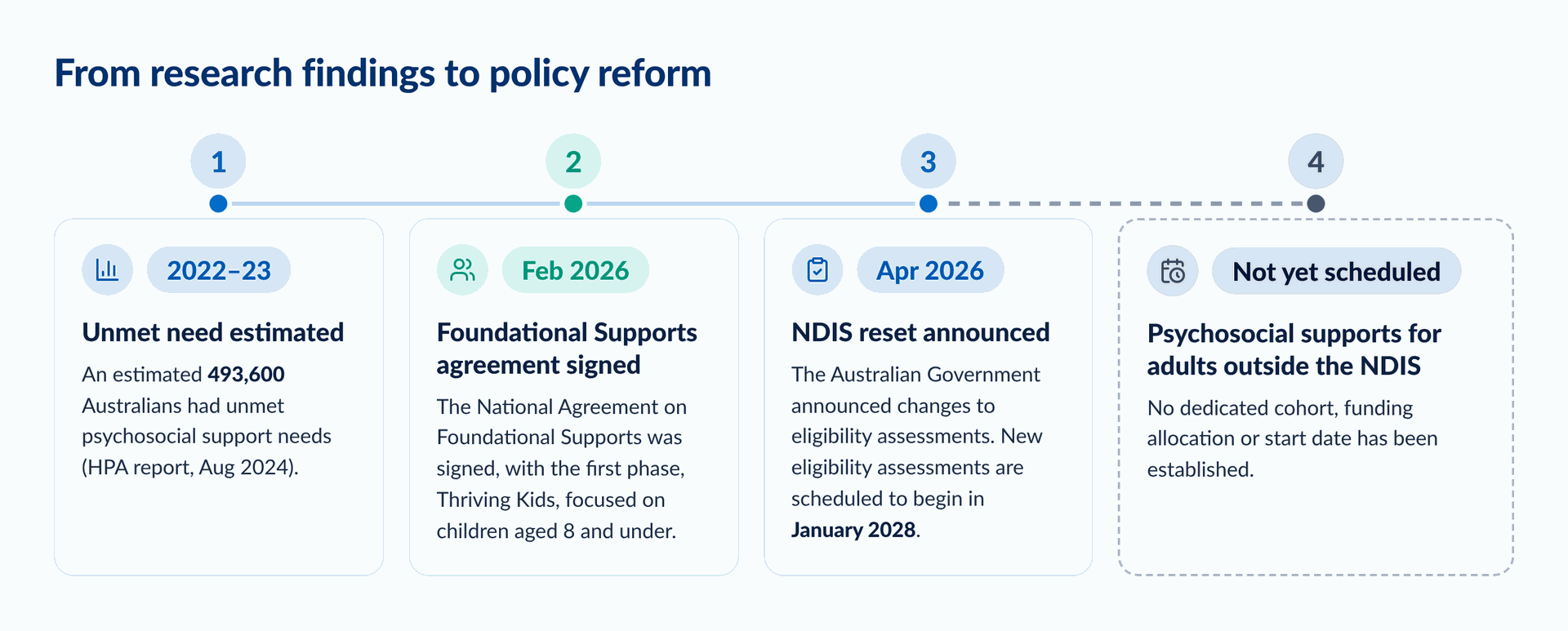
In February 2026 the Commonwealth and the states and territories signed the National Agreement on Foundational Supports, giving effect to a National Cabinet decision from December 2023. The agreement caps joint funding at $10 billion over the first 5 years, split equally between the Commonwealth and the states. It distinguishes between general supports, such as accessible information and community inclusion, and targeted supports for people whose needs fall between mainstream services and specialist NDIS support.
The first phase, Thriving Kids, is for children aged 8 and under with developmental delay or autism and low to moderate support needs. Up to $4 billion of the $10 billion is allocated to it. The first state-delivered services are due from 1 October 2026, with full rollout by 1 January 2028.
The National Agreement identifies psychosocial supports as a possible form of targeted assistance but does not define a dedicated adult psychosocial cohort, allocate funding specifically to it or establish a commencement date. Clause 49 provides for future cohorts to be negotiated through separate bilateral agreements.
Unmet psychosocial support needs have also been identified as a priority for future national mental health arrangements. However, those arrangements have not yet established a dedicated adult programme under Foundational Supports.For adults seeking psychosocial support outside the NDIS, the agreement does not establish a new dedicated service they can access. It also leaves unanswered which services will receive funding, when they will become available and how many people they will support.
When Support Outside Hospital Is Difficult to Arrange
A person may be ready to leave hospital but still need somewhere suitable to live and help with daily activities. If those arrangements are not in place, their discharge may be delayed.In Queensland, Level 3 supported accommodation is one option for people who need assistance with daily living. These residential services operate under the Residential Services (Accreditation) Act 2002 and provide accommodation and personal care services.
However, accommodation and psychosocial support are not necessarily funded or delivered through the same arrangements. Access to additional community-based support may depend on a person's eligibility, available services and funding.
Discharge planning therefore requires health, housing and disability services to coordinate accommodation, funding and ongoing support before a person returns to the community.

What Happens When a NDIS Application Is Unsuccessful?
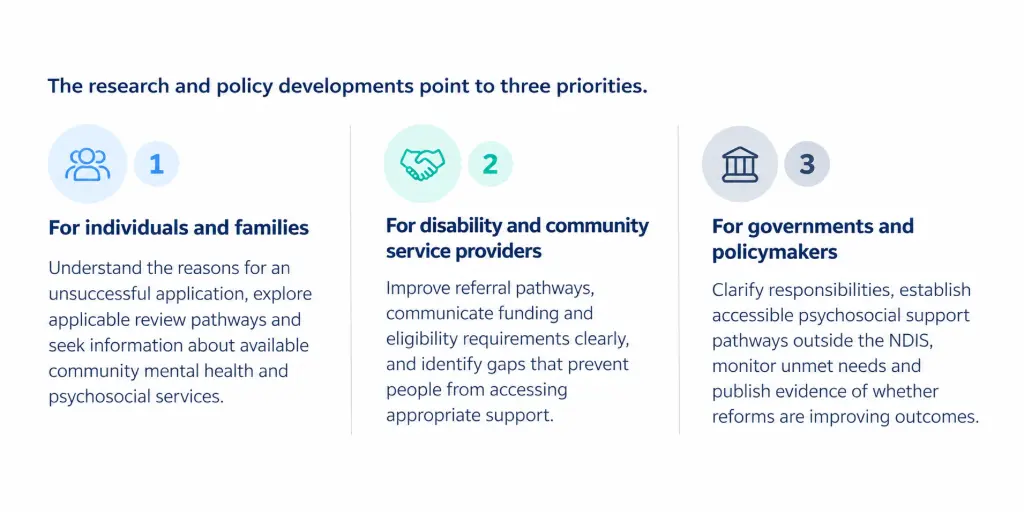
An unsuccessful NDIS application does not close off other options. The person can ask for a review of the decision. They may also be able to access a community mental health programme or a psychosocial service funded outside the scheme. Finding that service is often the difficult part. What exists depends on location, the program’s own eligibility rules, how it is funded and whether the provider has capacity. The person, or their family, may need to work through disability, health, housing and community systems, each with its own entry point.
Even when someone is referred to a community service, they may still face a waiting list or find that the programme is unavailable in their area.
Who Is Accountable for People Outside the NDIS?
Responsibility for psychosocial support is shared between the Commonwealth, states and territories, mainstream mental health services and community organisations. For people seeking assistance, this can make it difficult to know which organisation is responsible for arranging support when NDIS funding is unavailable. The NDIS has defined access requirements and cannot be expected to fund every form of mental health support. People who do not meet those requirements still need support with everyday living.
The Australian Government, Queensland Government and NDIA have different roles in addressing these needs. Each has specific questions to answer about how people outside the NDIS can access support.
- Australian Government: How much funding is specifically allocated to adult psychosocial support outside the NDIS, and what services are currently available?
- Queensland Government: What is being done to address unmet community psychosocial need, what will Queensland fund for adults with psychosocial disability under the National Agreement on Foundational Supports, and how is progress being measured?
- NDIA: What do public access data reveal about psychosocial applicants, and how are unsuccessful applicants referred to alternative services?
Public answers to these questions would help establish which agencies are responsible for delivering support, how funding is being used and whether the reforms are reaching adults with psychosocial disability outside the NDIS.
What Needs to Happen Next?
The National Agreement on Foundational Supports recognises the need for disability assistance beyond the NDIS. The HPA research estimated the scale of unmet psychosocial support needs in 2022–23, providing a historical baseline against which future research can assess progress.While the agreement's first priority is support for children, adults with psychosocial disability still need clarity on what additional services will be funded and when they will become available.Governments could make it easier to assess progress by publishing which psychosocial services are available, where they operate, how long people wait and how many people receive support.
An unsuccessful NDIS application determines whether someone qualifies for that scheme. It does not mean they no longer need help with everyday living.
Sources and Further Reading
1. Health Policy Analysis (2024). Analysis of unmet need for psychosocial supports outside of the National Disability Insurance Scheme: Final report. Updated 15 August 2024.
2. National Disability Insurance Agency (2025–26). Quarterly reports to disability ministers and participant data downloads.
https://www.ndis.gov.au/about-us/publications/quarterly-reports
3. Commonwealth of Australia and state and territory governments (2026). National Agreement on Foundational Supports 2026–31. Commenced 2 February 2026; see provisions for targeted supports and future cohorts, including clause 49.
https://federalfinancialrelations.gov.au/agreements/national-agreement-foundational-supports
4. Commonwealth of Australia and state and territory governments (2026). National Agreement on Foundational Supports 2026–31: signed agreement (PDF).
5. Australian Government Department of Health, Disability and Ageing (2026). Thriving Kids: fact sheet, February 2026.
https://www.health.gov.au/sites/default/files/2026-02/thriving-kids-fact-sheet_0.pdf
6. Australian Government Department of Health, Disability and Ageing (2026). Supports being rolled out: Thriving Kids.
https://www.health.gov.au/our-work/thriving-kids/supports-being-rolled-out
7. The Hon Mark Butler MP (22 April 2026). Minister Butler speech at the National Press Club.
8. National Disability Insurance Agency (22 April 2026). Securing the NDIS for future generations: announcement.
https://ndis.gov.au/news/11496-securing-ndis-future-generations
9. National Disability Insurance Agency (2026). Securing the NDIS for future generations: legislation and staged implementation timeline. Eligibility changes scheduled for January 2028.
https://www.ndis.gov.au/ndis-laws/securing-ndis-future-generations
10. National Disability Insurance Agency (19 August 2026). New NDIS laws pass.
https://www.ndis.gov.au/news/11650-new-ndis-laws-pass
11. Health Ministers Meeting (13 June 2025). Special communiqué: psychosocial support priorities and future mental health arrangements.
12. Australian Government Department of Health, Disability and Ageing (2026). Psychosocial Project Group: remit and publication of unmet-need analysis.
https://www.health.gov.au/committees-and-groups/psychosocial-project-group
13. Queensland Government, Business Queensland. Accreditation for residential services: Level 3 personal care services.
https://www.business.qld.gov.au/industries/housing-accommodation/residential-service/accreditation
14. Queensland Government, Department of Housing and Public Works. Residential services legislation and accreditation levels.
https://www.hpw.qld.gov.au/news-publications/legislation/residential-services
15. Queensland Government. Residential Services (Accreditation) Act 2002.
https://www.legislation.qld.gov.au/view/whole/html/inforce/2024-02-08/act-2002-018
16. National Disability Insurance Agency (2026). What is a decision review? Internal and external review pathways.
https://ndis.gov.au/participants/changing-your-plan/decision-reviews/what-decision-review
17. National Disability Insurance Agency (2026). How to request a review of a decision. Three-month internal review deadline.
https://www.ndis.gov.au/participants/changing-your-plan/decision-reviews/how-request-review-decision
18. National Disability Insurance Agency (2026). Guide to decision reviews. Administrative Review Tribunal external review process.
https://www.ndis.gov.au/participants/changing-your-plan/decision-reviews/guide-decision-reviews

Australia’s psychosocial support gap: billions committed, but who is getting help outside the NDIS?